Germany adds just 34 km of new rail track in 2026, less than a marathon
Germany will open only about 34 kilometres of new or expanded rail line this year, fewer than in 2024 and 2025. Here is what is actually being built.
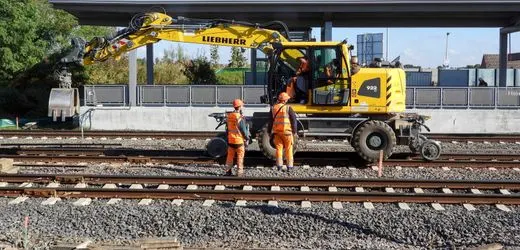
Less than the distance of a marathon: that is how much new or expanded railway Germany will put into service in 2026. The association of private freight railways (rivals of DB Cargo, the Deutsche Bahn freight arm) counted about 34 kilometres. Here is what is on the list.
1. A tiny share of the network
The 34 kilometres equal one thousandth of the network run by DB InfraGO, the Deutsche Bahn subsidiary responsible for infrastructure. That network covers around 33,400 kilometres.
2. Fewer kilometres than before
It is even less than in the already weak previous years. In 2025, 44 kilometres were added, and in 2024 it was 48.2 kilometres.
3. Berlin: a new S21 section
A new stretch of the S21, a Berlin S-Bahn (city rail) line, adds 3.7 kilometres.
4. North Rhine-Westphalia: two projects
A third track between Dinslaken and Voerde adds 4.6 kilometres. A new S-Bahn line between Troisdorf and Bonn-Beuel adds 8 kilometres.
5. Rhineland-Palatinate: a second track
Between Dernau and Rech/Altenahr, a second track opens over 2.2 kilometres.
6. Baden-Württemberg: the biggest chunk
Part of the third and fourth tracks on the Rheintalbahn (the Rhine Valley line) between Bashaide and Rastatt-Süd adds 15.8 kilometres. That is almost half of the total. Together, the five projects come to 34.3 kilometres.
7. Electrification crawls along
Only one section of existing track gets overhead wires this year: 2.6 kilometres between Chemnitz Hauptbahnhof and Chemnitz Süd.
8. The freight lobby wants more capacity
Managing director Peter Westenberger links the issue to low water on many rivers since the summer. In his view, it shows why Germany needs a more powerful rail network with reserves. He says 34 kilometres in a year is far too little for a country like Germany.
He also argues that renovation alone does not let a single extra train run. Extra capacity, he says, comes mainly from new tracks, passing places, strong junctions and electrification. The government should make capacity expansion a real priority again, alongside renovation. As he puts it, it comes down to political will.
For now, the numbers say Germany is building very little new railway.
Story timeline
Germany's slow rail network expansion · 2 updates
What happened before and after this story. Background events not previously covered were summarised by AI.
More in: News
See all →
Mystery letter sent Polish military police to hospital, now the case is closed

Michel Houellebecq charged over 2022 remarks about Muslims in a magazine interview

Sonia Gandhi's memoir reveals two secret cancer scares and surgeries abroad