Hayabusa2 changes course after engine trouble, heads for a fast-spinning asteroid
Japan's veteran probe Hayabusa2 can no longer reach its 2031 target after ion engine faults. Its new goal is a tiny asteroid that spins once every 49 minutes.
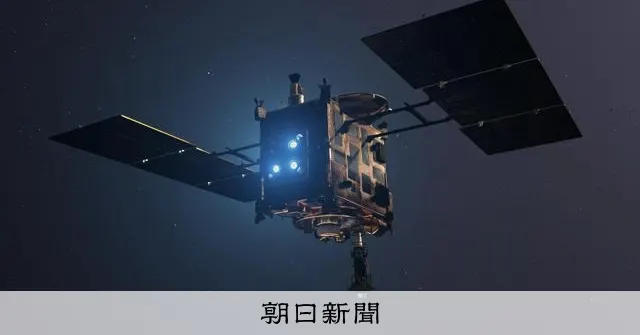
Hayabusa2, Japan's famous asteroid probe, is getting a new destination. Its ion engine has started to fail, so the spacecraft can no longer make the long trip to its planned target. The replacement is a tiny asteroid that spins faster than most of us manage a lunch break.
What happened?
JAXA (Japan's space agency) announced the change on 16 November at a meeting of a Cabinet Office subcommittee on space science and exploration.
The original plan was to reach the asteroid 1998 KY26 in 2031. That is now off the table. Instead, in fiscal 2028, Hayabusa2 will fly past an asteroid called 2015 BM510 at high speed and observe it as it goes.
The trouble began after this July's flyby of the asteroid Torifune. Hayabusa2 passed within about 400 metres of it at roughly 5.3 km/s and sent back photos and data. Soon afterwards, the ion engine, which steers the probe, suffered repeated electrical discharges and stopped firing properly.
JAXA tried to fix it. But the big orbit change needed to reach 1998 KY26 was judged too difficult. The probe was launched in 2014, and after more than 11 years its equipment is wearing out.
Why is everyone excited about the new target?
2015 BM510 is a near-Earth asteroid, probably 17 to 74 metres across. It turns once every 49 minutes or so. It is also a "D-type" asteroid, a class that may still hold material from the early days of the solar system.
No one has ever explored a fast-spinning D-type asteroid, so this would be a world first. Scientists want to know why it doesn't fly apart from centrifugal force. Its inner structure and origins could hold the answer.
There is a practical angle too. Dark objects tens of metres wide are hard to spot with a camera until you are very close. Learning to approach them accurately could help with planetary defence, meaning the idea of nudging an asteroid off a collision course with Earth someday.
What came before?
Hayabusa2 launched in 2014 and collected rocks and sand from the asteroid Ryugu. In December 2020 it dropped the sample capsule back to Earth, and it has been on an extended mission ever since. The Torifune flyby this July was a part of that journey.
What's next?
The new target means a flyby in fiscal 2028, not a long-awaited arrival in 2031. An ageing probe now has another chance to show what it can still do.
Story timeline
Hayabusa2 extended mission target change · 3 updates
What happened before and after this story. Background events not previously covered were summarised by AI.
What are you in the mood for?
Five little things made by the people behind Mulemo.
My brain wants a workout
SUMO: tap the tiles, add them up, hit the target. Dangerously easy to start.
 SUMOTry it
I want to finally speak that language
Dialo: chat with an AI partner that corrects every sentence and tells you why.
 DialoTry it
I need a gift and I have no idea
giftdetect: say who it is for and get ideas from real shops in minutes.
 giftdetectTry it
Give me the tech gossip
Osegi: curious tech news from around the world, in your language.
 OsegiTry it
I stare at EDI files for a living
ediviewer: reads EDIFACT and X12 like a normal document. On Mac and Windows.
 ediviewerTry it
More in: Tech
See all →
Kakao Bank finally adds Apple Pay, and teens as young as 14 can use it
Microsoft 365 outage hits 70+ countries: what we know about Outlook and Teams
Japanese team creates 'planimal' cells that mix plant and animal traits