Earth's radiation shield wasn't as tight as thought, Japan's Arase probe finds
A 5,000-fold jump in ultra-fast electrons during the May 2024 solar storm suggests the barrier around Earth's radiation belts can be crossed after all.
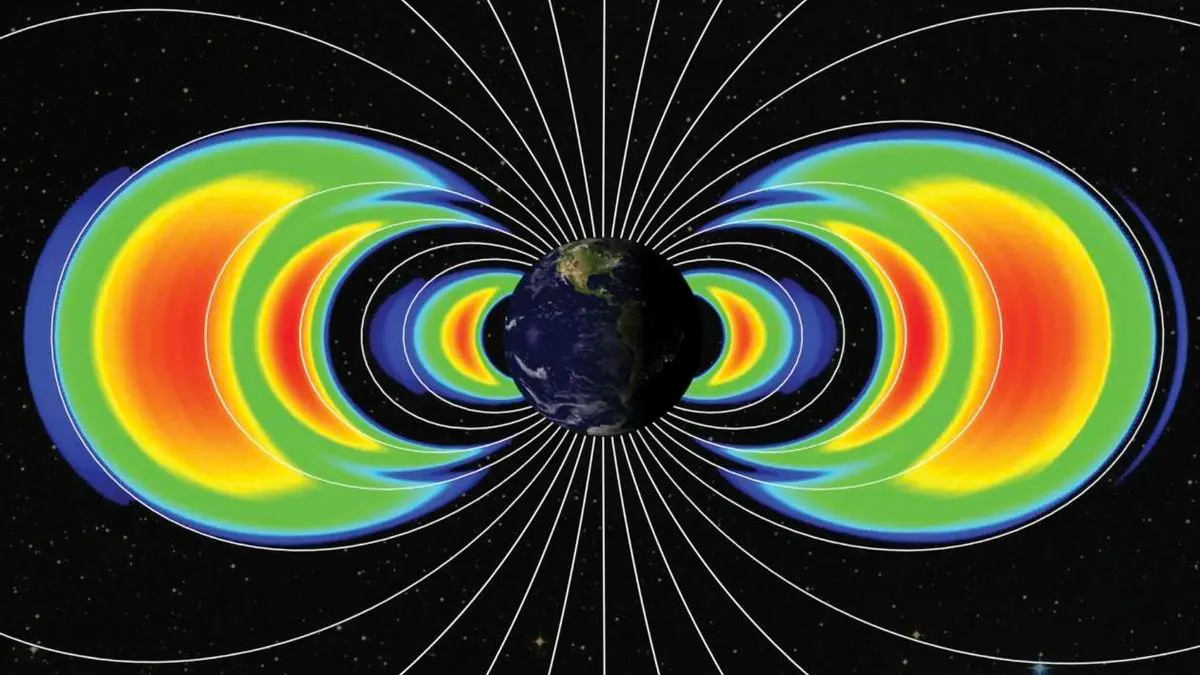
For a decade, scientists pictured a kind of invisible wall inside the radiation belts around Earth. Now Japan's Arase satellite has watched it get breached.
During the extreme solar storm of May 2024, the number of very high-energy electrons in that zone shot up more than 5,000 times. That's a big problem for the old picture.
What happened?
In May 2024, a series of eruptions on the Sun threw billions of tonnes of magnetised plasma towards us. The result was a G5 storm, the top level on NOAA's scale (the US weather and ocean agency). Solar wind hit 1,200 kilometres per second.
A team led by space physicist Yoshizumi Miyoshi of Nagoya University analysed Arase's data. Their study, published in Geophysical Research Letters, found that electrons of around three megaelectronvolts surged more than 5,000-fold.
The increase came in stages. Lower-energy electrons grew first. About twelve hours later, higher-energy ones appeared, and roughly a day after that, those above three megaelectronvolts rose too.
Why does it matter?
The Van Allen belts are two regions of particles trapped by Earth's magnetic field. The inner one is mostly protons, while the outer one holds lots of energetic electrons.
In the team's reading, the storm drained dense cold plasma from the plasmasphere, a region around Earth that normally dampens certain waves. That let so-called chorus waves pass energy to electrons, speeding them up to near light speed. The particle distribution peaked close to the boundary, which points to acceleration on the spot rather than transport from farther out.
Why care? These particles can pass through satellite shielding and damage sensitive electronics. They also raise radiation risks for astronauts crossing those regions.
Remind me: what was the old idea?
In 2014, NASA's Van Allen Probes found a sharp inner boundary, about three Earth radii from the planet's centre, that the most energetic electrons rarely crossed. Physicist Daniel Baker compared it to a glass wall.
One explanation was that certain waves pushed electrons towards the atmosphere, while their inward drift was too slow to get past.
What's next?
Arase recorded a gradual fall in ultra-relativistic electrons until October 2024, when another storm changed conditions again. The study looks at one extreme event. Whether weaker storms can trigger the same acceleration is still an open question.
Story timeline
Arase probe and Earth's radiation barrier · 3 updates
What happened before and after this story. Background events not previously covered were summarised by AI.
More in: Tech
See all →
Samsung may charge for Galaxy AI: a $4.99 monthly plan is reportedly in the works

Kolmar Korea's AI lip color maker wins top CES beauty award

Sony's new PlayStation Portal has built-in storage, but only in Japan