Delhi's smog is so thick you can see it from space, two days after Diwali
NASA satellite images show a grey blanket of haze over northern India on 10 November. Delhi's air improved slightly to 'poor', but the haze isn't going away.
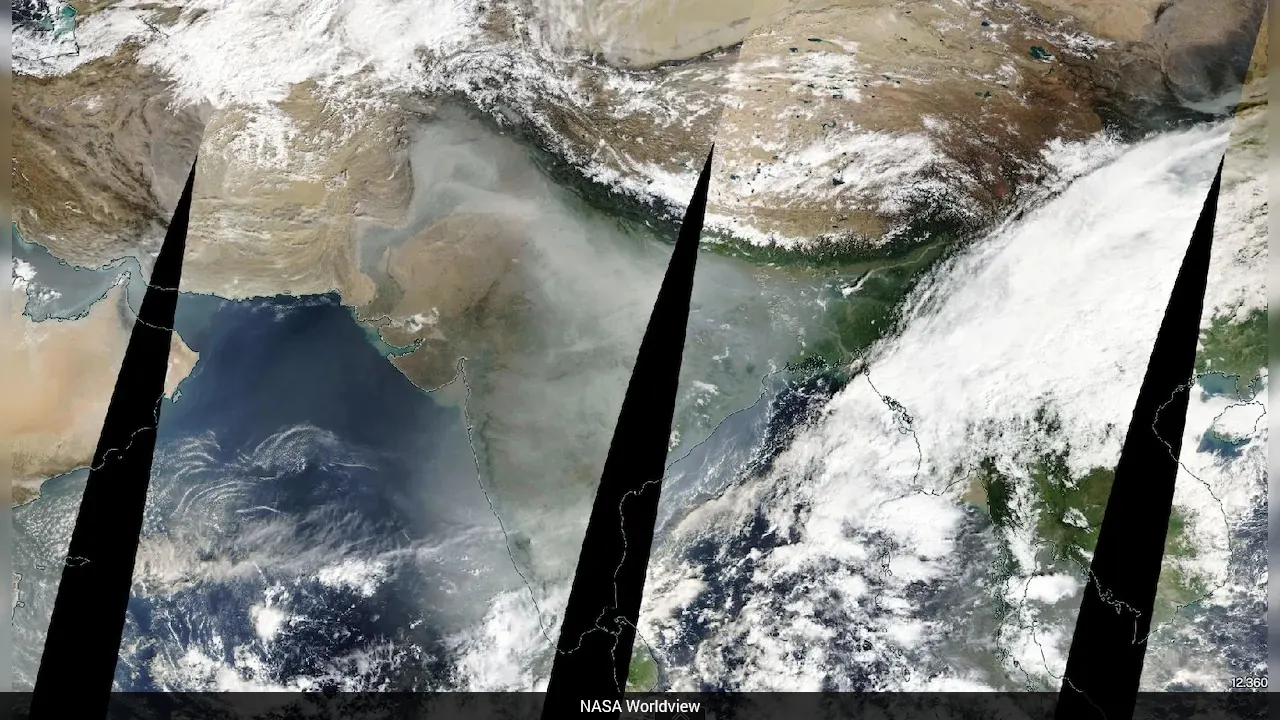
Zoom out far enough and northern India looks like it's wrapped in a grey blanket. That's exactly what satellite images showed on 10 November, two days after Diwali, the festival of lights.
The pictures come from NASA Worldview, a free web tool that maps satellite views of Earth. And they're not pretty.
What do the images show?
On 10 November, the haze was thickest over Delhi, neighbouring Uttar Pradesh and some surrounding states. It also stretched north into the Himalayan states of Uttarakhand, Himachal Pradesh and Jammu and Kashmir.
Much of central and southern India was under haze too, though a lot thinner. Only the western states, such as Rajasthan and Gujarat, and the northeastern states looked mostly clear.
The haze arrives every year as temperatures drop. This time, it was big enough to see from orbit.
How did it change over three days?
On 8 November, Diwali day, Delhi, western Uttar Pradesh and other northern regions were already smothered in a heavy shroud. Firecrackers set off during the festival usually cause an instant spike in pollution.
On 9 November, the haze looked thinner and more scattered. It covered Delhi, Uttar Pradesh, Bihar and a few other northern states. A day later, it had spread much wider.
It has stayed stubbornly over India throughout November, even if its shape and position keep shifting.
What's the air actually like in Delhi?
On Monday, Delhi's AQI (Air Quality Index, a 0–500 pollution score) hit 376, which counts as 'very poor'. On Tuesday it eased to 299, in the 'poor' category, according to the CPCB (India's Central Pollution Control Board). Stronger winds across the region helped.
For reference, the CPCB scale runs like this: 0–50 is 'good', 51–100 'satisfactory', 101–200 'moderate', 201–300 'poor', 301–400 'very poor' and 401–500 'severe'. So 299 is better, but only just.
What happened before?
Last year, India's Supreme Court allowed 'green' firecrackers, a lower-emission type, in Delhi-NCR (the capital region) for limited hours around Diwali. Delhi's air still turned 'very poor' after the celebrations, with widespread firecracker use despite the curbs.
This year's images suggest the problem hasn't gone anywhere.
Story timeline
Delhi post-Diwali smog and air pollution · 3 updates
What happened before and after this story. Background events not previously covered were summarised by AI.
More in: News
See all →
Three-hour blackout hits central Madrid: whole streets went dark at noon

Abu Dhabi talks: Russia gets Europe's security on the US agenda
David Walliams accused of preying on young women; he denies wrongdoing